Exercise and PKD: Is It Safe to Exercise with Polycystic Kidney Disease? | PKD Lifestyle
For many people living with polycystic kidney disease (PKD), exercise can feel intimidating. Questions about cyst rupture, kidney damage, elevated heart rate, or “pushing too hard” are common concerns. Some people avoid physical activity altogether out of fear that exercise could worsen their condition.
The good news is that, for most individuals with PKD, exercise is not only safe but strongly encouraged. Regular physical activity supports cardiovascular health, muscle strength, mobility, and overall quality of life. However, because PKD can affect both the kidneys and cardiovascular system, exercise may require additional precautions and individualized planning.
This blog will discuss why exercise matters in PKD, how to safely monitor exercise intensity, how exercise recommendations may change as PKD progresses, and how to recognize when exercise may be too intense for your body.
Understanding PKD
Polycystic kidney disease (PKD) is a genetic disorder that causes numerous fluid-filled cysts to develop in the kidneys. Over time, these cysts grow and can interfere with normal kidney function, eventually leading to chronic kidney disease (CKD), kidney failure, or end-stage renal disease (ESRD).
There are two primary forms of PKD:
- Autosomal Dominant Polycystic Kidney Disease (ADPKD): the most common form, usually diagnosed in adulthood.
- Autosomal Recessive Polycystic Kidney Disease (ARPKD): a much rarer form that typically presents early in life and affects both the kidneys and liver.
As cysts enlarge, the kidneys themselves can become dramatically larger. A normal kidney weighs about 300 grams, while a PKD kidney may eventually grow to the size of a football and weigh over 2 kilograms. PKD can also involve cysts in other organs, including the liver, ovaries, and brain.
One of the major complications associated with PKD is high blood pressure (hypertension). As cysts enlarge, they can damage kidney tissue and contribute to rising blood pressure. Hypertension is one of the largest contributors to cardiovascular disease risk in PKD, and increases the risk of brain aneurysms and brain bleeds. Because of this, cardiovascular health is an important part of PKD management, and exercise can play a major role.
Why Exercise Matters in PKD
Although research specifically examining exercise in PKD remains limited, there is strong evidence supporting the benefits of physical activity in chronic kidney disease overall. Regular physical activity can help improve blood pressure control, reduce cardiovascular disease risk, maintain muscle strength and mobility, reduce frailty, and support mental health and overall quality of life.
Although there is currently no strong evidence proving that exercise directly slows cyst growth in PKD, maintaining physical fitness remains extremely important. Regular movement can help preserve strength, function, cardiovascular health, and independence as the disease progresses.
What Types of Exercise Are Generally Safe?
For most people living with PKD, light-to-moderate intensity exercise is considered the safest and most sustainable approach. Activities such as walking, cycling, swimming, light jogging, yoga, stretching, elliptical training, and low-impact recreational sports are generally well tolerated. Resistance (strength) training can also be beneficial when using light-to-moderate weights and proper technique.
When we exercise, it is normal for heart rate and blood pressure to rise. However, research suggests that some people with PKD may experience larger increases in blood pressure during exercise and slower recovery of heart rate afterward. In PKD, the kidneys and blood vessels may already be under additional stress due to high blood pressure, enlarged kidneys, and changes in blood flow regulation. Because of this, monitoring how hard the body is working during exercise becomes especially important.
If activity remains too intense for too long, the prolonged increase in heart rate and blood pressure may place additional strain on the kidneys and cardiovascular system. This highlights the importance of exercising at an appropriate intensity and paying attention to how the body responds during and after activity. Understanding how to safely monitor exercise intensity can help people with PKD exercise more confidently and safely.
Understanding Safe Exercise Intensity: Heart Rate vs. The RPE Scale
Because PKD can affect how the cardiovascular system responds to exercise, learning how to monitor exercise intensity safely is especially important. Many people use heart rate to guide exercise intensity, but this may not always be accurate for individuals with PKD, particularly for those taking medications such as beta-blockers that can alter heart rate response during activity.
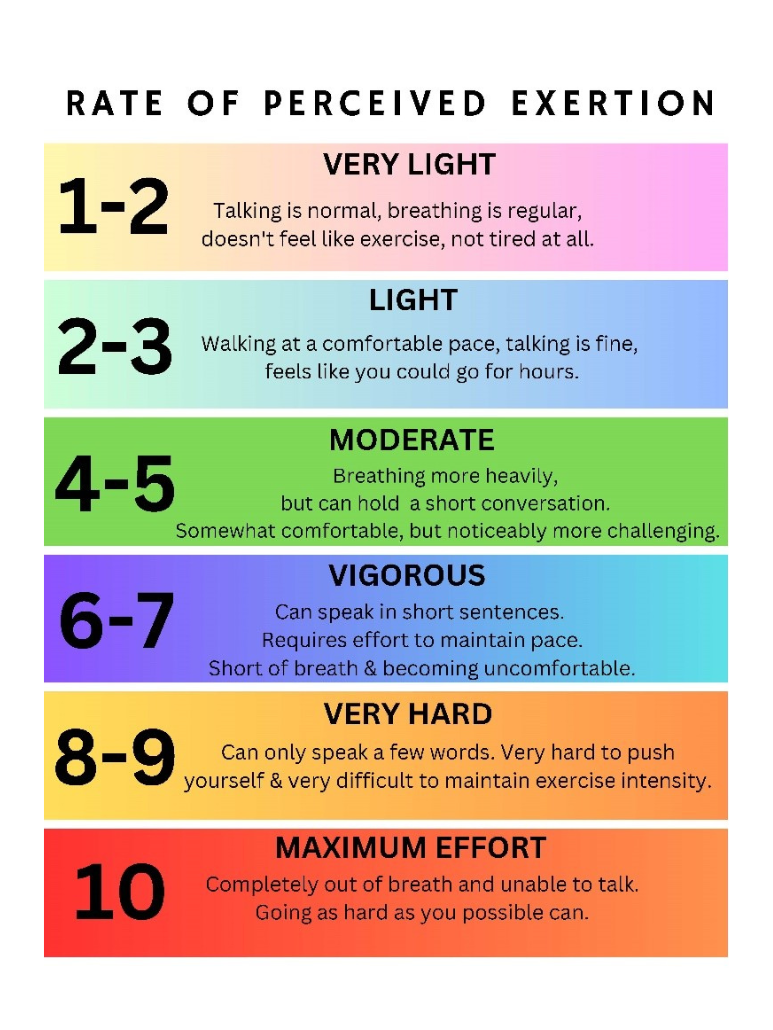 For this reason, the Rating of Perceived Exertion (RPE) scale is often a more practical tool. The RPE scale measures how hard exercise feels based on breathing, fatigue, and overall effort, rather than relying only on a heart rate number.
A safe exercise intensity for individuals with PKD is typically:
- Light intensity (RPE 2-3/10): able to comfortably hold a conversation.
- Moderate intensity (RPE 4-6/10): breathing harder but still able to speak in short sentences.
It is important to remember that the RPE scale is highly individual. Walking may feel light (2-3) for one person but moderate (4-5) for another. Similarly, swimming or cycling may feel manageable for some individuals, while others may find the same activity more strenuous.
The goal is not to match a specific activity to a certain number, but to pay attention to how your body responds during and after exercise. In most cases, exercise should feel somewhat challenging but still controlled. If a person becomes dizzy, extremely short of breath, unable to speak comfortably, or notices prolonged recovery afterward, the intensity may be too high.
How Exercise Safety Changes as PKD Progresses
Exercise recommendations often change as PKD progresses. In the earlier stages of PKD, many individuals can participate in a wide range of activities with minimal limitations. However, as the kidneys enlarge, symptoms such as abdominal fullness, flank pain, reduced mobility, and discomfort with bending or twisting may become more noticeable and may affect exercise tolerance.
As PKD progresses, exercise plans often need to become more individualized and symptom-guided. For example, one person with advanced PKD may find that chair exercises and stretching feel appropriate, while another may tolerate short walks with rest breaks. There is no “one-size-fits-all” approach to exercise with PKD.
The 2021 KDIGO guidelines recommend aiming for 150 minutes of physical activity per week. However, it is important to remember that this is the goal, not the starting point. Many people may need to begin slowly and gradually build up over time.
For example, starting with a 20-minute walk twice per week may be an appropriate first step. While reaching 150 minutes per week is ideal, some individuals with advanced PKD may only tolerate short periods of movement each day, and that is still beneficial.
Brain Aneurysms and Exercise Precautions
One of the most serious complications associated with PKD is an increased risk of intracranial aneurysms and subarachnoid hemorrhage (brain bleeds). Uncontrolled high blood pressure significantly increases this risk. Individuals with a personal history of aneurysm, known brain aneurysm, previous brain bleeds, or a family history of sudden unexplained death should discuss exercise recommendations with their physician before starting an exercise program.
In some situations, heavy lifting or strenuous exertion may be discouraged due to concerns about sudden spikes in blood pressure. If you have been diagnosed with an intracranial aneurysm, weightlifting and heavy resistance training should be avoided unless specifically cleared by your medical team.
How Can You Tell if Exercise Is “Too Risky”?
Exercise may be too intense or unsafe if your heart rate remains elevated for a prolonged period after activity, blood pressure becomes difficult to control, symptoms worsen significantly, or flank pain develops. Other warning signs may include dizziness, light-headedness, nausea, excessive shortness of breath, or unusually prolonged recovery. A safe exercise program should feel appropriately challenging without leaving you feeling completely depleted.
Final Thoughts
Exercise remains an important part of overall health for individuals living with PKD. While some precautions may be necessary, avoiding physical activity altogether is usually not the answer. For most individuals with PKD, exercise should remain in the light-to-moderate intensity range and feel comfortable and sustainable over time. The 2021 KDIGO guidelines recommend aiming for 150 minutes of physical activity per week, but this should be viewed as a long-term goal rather than a starting point. Most importantly, remember that PKD affects everyone differently. Start where you are, progress gradually, and focus on progress over perfection. Even small amounts of regular movement can have meaningful long-term benefits for health and quality of life.
About the Author
Katie Bakgaard, BKin, ACSM-CEP, is the Clinical Exercise Physiologist for the Transplant Wellness Program (TWP). With a background in cardiac rehabilitation, Katie specializes in supporting patients with chronic illness through exercise and wellness programming to help them build confidence in movement, stay active, and improve their overall quality of life.
More
- For more PKD-friendly fitness, wellness, movement, and everyday health resources, browse our PKD lifestyle blog.
- Try one of our PKD-friendly workouts on our YouTube channel.
- Watch the Transplant Wellness Team talk about their program, from our 2025 PKD Summit.
- Learn more about the Transplant Wellness Program.
- Watch this video about exercise and PKD, also from our 2025 PKD Summit.
References & Resources
KDIGO Clinical Practice Guideline for the Management of CKD
How to Measure Exercise Intensity: Learning how to use Rate of Perceived Exertion Scale.
- Cheung, A.K.; Chang, T.I.; Cushman, W.C.; Furth, S.L.; Hou, F.F.; Ix, J.H.; Knoll, G.A.; Muntner, P.; Pecoits-Filho, R.; Sarnak, M.J.; et al. KDIGO 2021 Clinical Practice Guideline for the Management of Blood Pressure in Chronic Kidney Disease. Kidney Int. 2021, 99, S1–S87.
- Mustata, S.; Groeneveld, S.; Davidson, W.; Ford, G.; Kiland, K.; Manns, B. Effects of exercise training on physical impairment, arterial stiffness and health-related quality of life in patients with chronic kidney disease: A pilot study. Int. Urol. Nephrol. 2011, 43, 1133–1141.
- Aucella, F. Physical Activity in ADPKD and CKD Patient. G. Di Tec. Nefrol. E Dial. 2015, 27, 204–209.
- Reinecke, N.L.; Cunha, T.M.; Heilberg, I.P.; Higa, E.M.S.; Nishiura, J.L.; Neder, J.A.; Almeida, W.S.; Schor, N. Exercise capacity in polycystic kidney disease. Am. J. Kidney Dis. 2014, 64, 239–246.
- Villanego, F.; Naranjo, J.; Vigara, L.A.; Cazorla, J.M.; Montero, M.E.; García, T.; Torrado, J.; Mazuecos, A. Impact of Physical Exercise in Patients with Chronic Kidney Disease: Systematic Review and Meta-Analysis. Nefrología 2020, 40, 237–252.